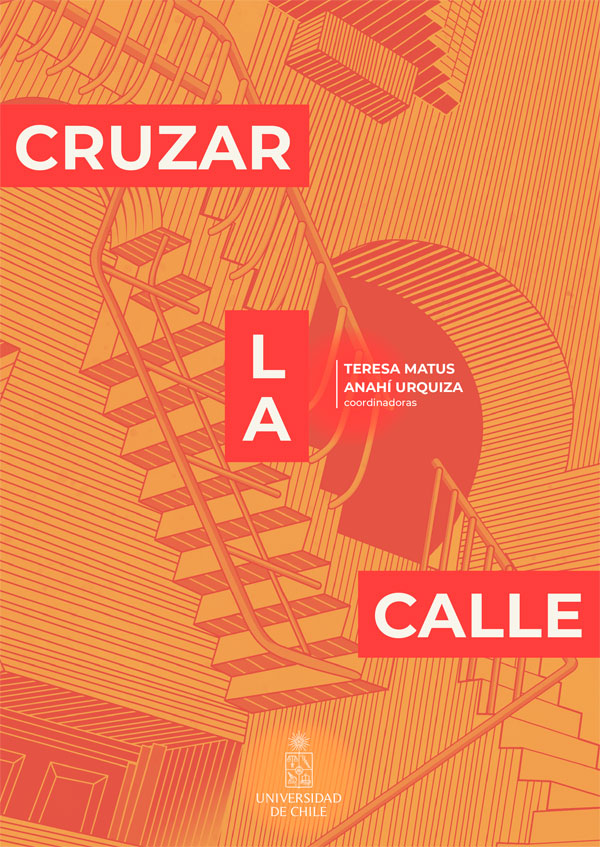
Book
Cross the street
Coordinators: Teresa Matus & Anahí Urquiza
Compilers: Carolina Leiva, Jesús Santorcuato & Paulina Espinoza
Suggested quote: Matus, T., & Urquiza, A. (Coords.)., Leiva, C., Santorcuato, J., & Espinoza, P. (Comps.). (2025). Cruzar la calle. Universidad de Chile.
Crossing the Street argues that the current context of polycrisis requires systemic responses that address the depth and complexity of global and national challenges. The book proposes a logic that embraces failures, critical issues, and imperfections as drivers of disruptive innovation, showing how to avoid repeating ineffective approaches and proposing new possibilities. Its grammar advances step by step, exposing disruptions and limitations as part of the innovative power of a Co-laboratory of Innovation with Public Purpose.
The text develops five cross-cutting approaches—polycentric collaboration, transdisciplinary knowledge, technological incorporation, innovation with implementation, and early measurement of effectiveness—that make up a new model of transfer guided by public purpose. From this perspective, research and its flow of innovations mark turning points, expand contingencies, and reveal opportunities for choice, linking knowledge production with governance capable of bringing together universities, public bodies, companies, foundations, and national and international centers.
The book places this approach in the context of the University of Chile as a Frontier University, highlighting the advances associated with the ICAI Platform and the gaps in governance, infrastructure, postgraduate studies, lines of research, international collaboration, and public participation. From there, it describes the role of the Co-laboratory of Innovation with Public Purpose (CLIPP) in bridging the gap between research and implementation through open science and a polycentric ecosystem of innovation and transfer.
It also reviews the national and international landscape of public agencies, institutions, companies, foundations, and networks involved in innovation for public purposes; the tensions between modernity and modernization; and the challenges faced by Chile and its actors in sustaining agendas for change in a context marked by polycrisis, mistrust, and institutional blockages.
Take a sniff
Download the book
© 2025, Universidad de Chile
First edition: November 2025, Santiago, Chile
This project was peer-reviewed. The text was also evaluated by experts from public and private institutions.
Editorial direction and proofreading: Publicaciones Universidad de Chile
Design: Beatriz Pérez
Layout: Pablo Fante
Printed ISBN: 978-956-19-1421-6
Digital ISBN: 978-956-19-1422-3
This book is licensed under Creative Commons 4.0 International: Attribution-NonCommercial.
