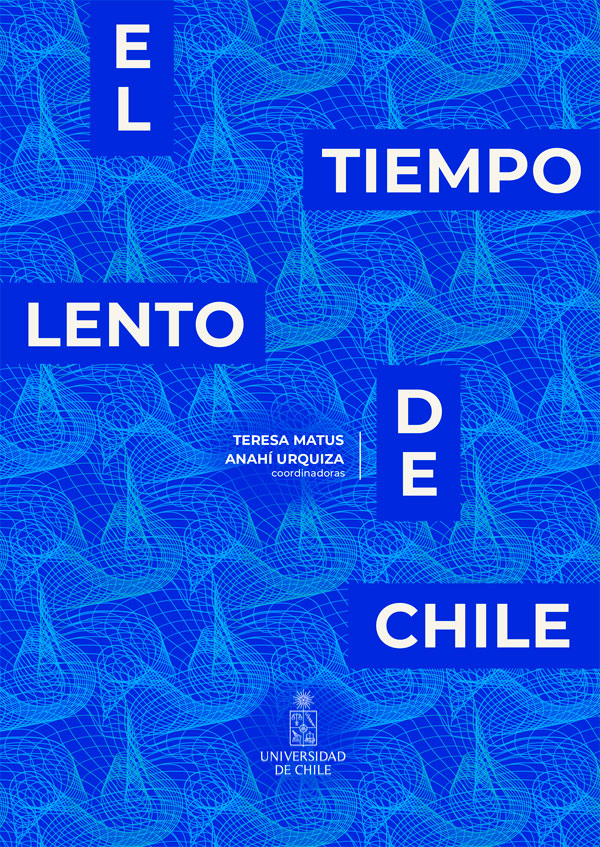
Book
Chile's slow pace
Coordinators: Teresa Matus & Anahí Urquiza
Compilers: Estefanía Vilches & Jesús Santorcuato
Suggested quote: Matus, T., & Urquiza, A. (Coords.)., Vilches, E. & Santorcuato, J. (Comps.). (2025). El tiempo lento de Chile. Universidad de Chile.
El Tiempo Lento de Chile is based on a principle of hope understood as action and commitment, bringing together reflections that call for addressing unfulfilled agendas and paving the way for sustainable development through valuable ideas and proposals based on diverse scientific research. The text is part of a series of calls to action from different sectors, recognizing the need to build a common purpose among businesses, the government, academia, and civil society.
The book explores the tension between slow time—marked by delayed policies and programs—and the technological acceleration that transforms the contemporary experience of time. Through references to Derrida, Benjamin, Cioran, Hirschman, Mascareño, Von Wolfersdorff, Wallerstein, Streeck, Deleuze, and Pelbart, it examines the paradoxes of time, its ruptures, discontinuities, and effects on the social, political, and economic life of the country. These distinctions allow us to understand the implications of time exploding into phenomena of inclusion-exclusion, postponed crises, expectations regarding development, and the need to face scenarios of risk, uncertainty, and conflict.
Based on this analysis, El Tiempo Lento de Chile understands innovation as a way of observing in order to transform what can be done differently today. The text reviews the four “Chiles” described by Jorge Katz, the temporality of poverty presented by Güell, and the tensions between modernization and modernity pointed out by Lechner, placing these diagnoses in a context that requires responses capable of adding value in the face of the contradictions of the present.
In its final section, the book presents 29 policy briefs that condense relevant knowledge, experiences, and recommendations for synchronizing the timelines of science, social urgency, and institutional transformation. These proposals address complex phenomena from innovative perspectives and are organized around nine fields linked to research, innovation, and transfer.
Take a sniff
Download the book
El tiempo lento de Chile - EPUB for Kindle
El tiempo lento de Chile - EPUB
© 2025, Universidad de Chile
First edition: November 2025, Santiago, Chile
This project was peer-reviewed. The text was also evaluated by experts from public and private institutions.
Editorial direction and proofreading: Publicaciones Universidad de Chile
Design: Beatriz Pérez
Layout: Pablo Fante
This book is licensed under Creative Commons 4.0 International: Attribution-NonCommercial.
